-
Recently, I have filmed on mostly wildlife blue-chip shoots that largely call for long-lens and drone skills. However, I have worked intensely on projects that incorporate lots of human actuality shooting for expeditions or presenter-led projects. These involve handheld operation and gimbals in addition to wildlife sequences. In many of these sync shoots I have directed lighting for interview set ups or for enhancing a scene’s natural light.
On ships I film topside, remotely operated cameras, and drone.
-
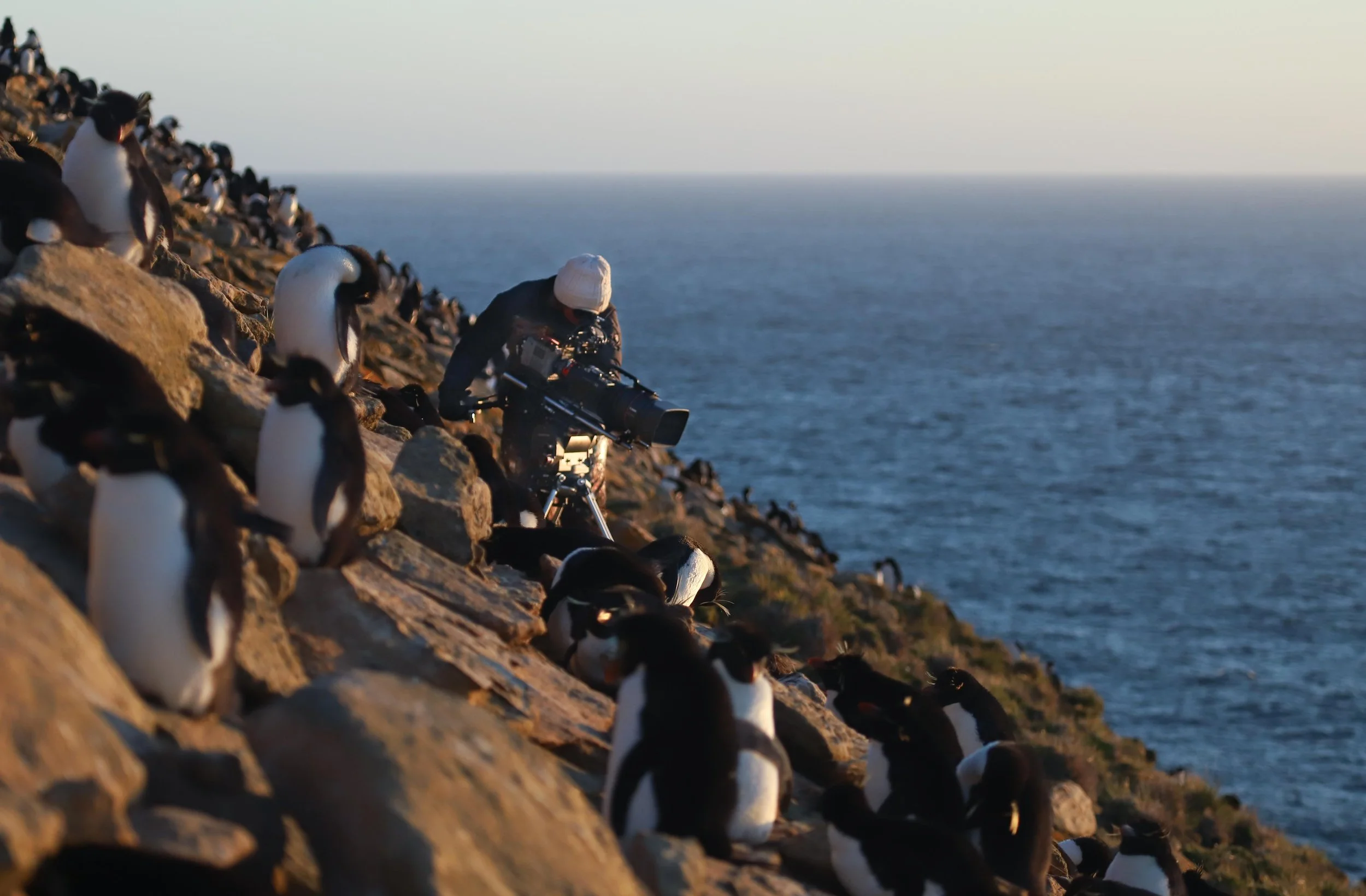
I am based in Seattle, Washington in the USA’s Pacific Northwest. I also spend winters (Southern summers) in the Falkland Islands and have filmed there extensively. Please reach out to ask about my availability - I’m happy to film anywhere in the world.
As far as experience goes, I grew up in the Midwestern fields and forests of Ohio, Indiana and Wisconsin. I have also filmed a lot in the swamps and ranch lands of Florida and still often visit family there. I filmed for 4 years in Southern California and I have also filmed in the great plains of Oklahoma, remote coast of Alaska, redwood forests of Northern California, and woods of Virginia. There aren’t many habitats I haven’t experienced in the US! Outside of the States, I have filmed in Antarctica, Madagascar, Mexico and South Africa.
-
I own a RED V-Raptor S35, and have access to a Canon CN-20
-
Yes, but please contact me for a link to my show reel. Unfortunately, I do not own most of the footage and therefore it must be kept private.
-
As a video engineer on the Exploration Vessel Nautilus I am responsible for all critical deliverables during and after the dives. While the remotely operated vehicles (ROVs) descend to the sea floor, I remotely control the cameras in coordination with the ROV pilots, and also direct which video feeds are showing on which screens in the ship, the control van, and on the live stream, “Nautilus Live.” No, I don’t get sea sick!
Work Inquiry FAQ
-
For more insight into this career, I recommend reading the resources and blogs from these very talented wildlife filmmakers and organizations:
Stephanie Foote has compiled tons of career advice and resources on her site
MPB camera reseller’s guide to wildlfe photography and filmmaking
Nina Constable’s guide to becoming a wildlife filmmaker
Check out the Wildlife Cinematographer Diversity Fund for a community of diverse cinematographers and support resources
A review of a career as a wildlife cinematographer by Sophie Darlington
Visit the International Association of Wildlife Filmmakers (IAWF) for guidance on rates and contracts
Join The Collective with Jackson Wild to expand your network and to find free learning opportunities
Jeff Hester provides some advice as an experienced underwater cameraman
Valuable tips from long-time cameraman Warwick Sloss
-
Wildlife filmmaking was a dream of mine since I was little, though I didn’t even know what to call it then. I just knew that piecing together bits of animal behavior knowledge, visual arts, and storytelling might one day get me to a place where I could reach people. Starting out, I made sure to practice on my DSLR in manual mode so I understood how it worked and so operating became muscle memory. I took initiative to make short films as class projects and for clubs I was involved in to practice my passion. I sought out internships and jobs in related areas, like animal husbandry and photography editing. I was also open to finding mentors and learning from others along the way - many kind people over the years took time to talk to me and answer my questions about this career.
In addition to school, these are the things that helped me most - you can learn more of my path on my “about” page.
-
I started on the Nautilus as a video engineering intern after I had completed my Master’s degree. However, many interns are younger and still in undergrad. As with all wildlife filming, the most important attributes are being genuinely passionate and curious about the natural world, and being someone that can get along with and work well with others in difficult situations. Volunteering for local wildlife outreach places locally and excelling in wildlife field research jobs showed those traits in me. OET is also very passionate about their interns growing and learning from the experience, so make sure you have goals in mind and know how this opportunity could help further them.
There are internships on the Nautilus for different departments too, including engineering, science communications, and biology/research. Each year there are many new science communication fellows on board as well, for people who are more established educators.
For a great overview of the application process for the video engineering internship, read Samantha-Lynn Martinez’s blog about it: https://samanthalynnmartinez.com/fieldnotes/nautilus-app
-
Though I attended the University of the West of England’s (UWE) Wildlife Filmmaking Masters course, it is not essential. Everybody’s path is different, and whether going to more school will help you or not depends on your experience to date. The filmmaking industry as a whole is not concerned with degrees and grades, but more with real experience and the visuals to back it up. I decided the course would help me because I came from a background in wildlife ecology and felt I needed the help in learning the production process. The one-year course did help me get a handle on how the industry works - the lingo, expectations, styles, and process. However, completing a program in wildlife filmmaking will not guarantee you a job in the industry, no matter what you will always need to exhibit perseverance, teamwork, curiosity, creativity, initiative, and adaptability to make it as a wildlife filmmaker, and you don’t necessarily learn those skills in school.
-
This is a similar answer to attending a program for wildlife filmmaking - living in Bristol will not guarantee you a job in the industry. It is maybe more helpful for people looking to be researchers and move up the producer track, as those positions often work in the production offices but I do know successful wildlife producers in the US as well. As a cinematographer, I have found it most helpful to understand animal behavior, to be out in the field practicing filming different species in different habitats, and to grow my field skills. That way I can contribute sequence ideas, stock footage, and confidently say that I have relevant experience. I do continue to visit Bristol almost once a year in order to meet with producers and network.
No matter where you live, I always advise you to nurture your local network of creatives, storytellers, conservationists and filmmakers as well.